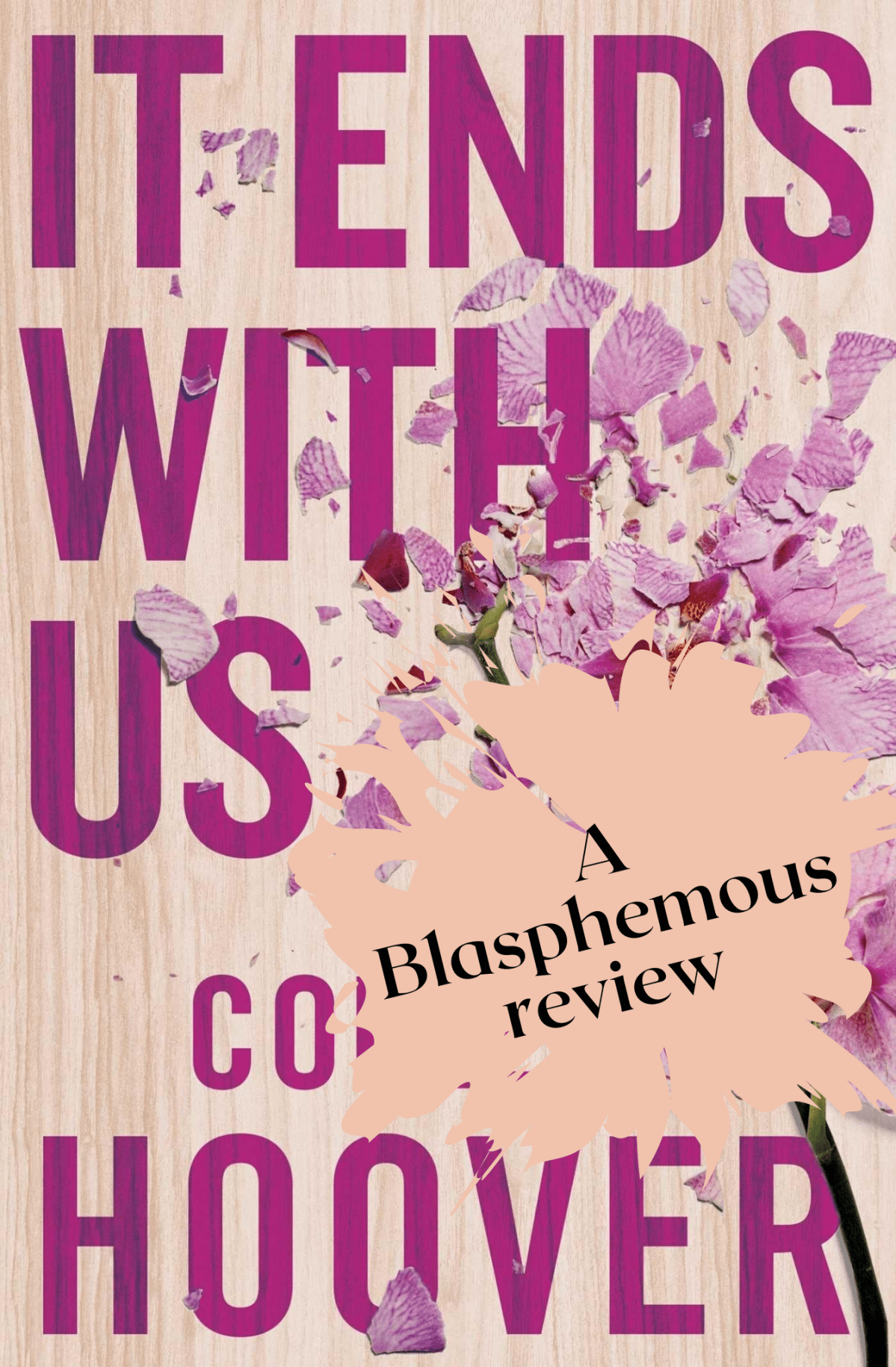
A friend once asked me, « Hey what do you think is better, old books or contemporary books?”. As the owner of a literature degree, I told him there is no supremacy one has over the other and that some people only think old books are better because solely the best survived the test of time. A literary survivor bias if you will. Now, do I think It Ends with Us by Colleen Hoover will survive the test of time? No.
I won’t claim to foresee the future, or that a book has to be a literary masterpiece for people to enjoy reading it, but when it comes to It Ends with Us, I have a lot to say, both in terms of criticism and of praise. So needless to say, spoilers are ahead.
Table Of Content:
- Let’s start with what could have been done better:
- Now for the few things I did like:
- TLDR- But I also have a certain theory:
Let’s start with what could have been done better:
On an editorial level, I feel there was a wasted opportunity when it came to the format of the letters Lily was “sending” to Ellen. I’m always sad to see contemporary romances fail to put the paratext of their books to good use, but here, it felt like the format was just good enough to get the message across. Nothing more nothing less.
I also want to say that I appreciate it when authors try to forgo the traditional flashback to tell us about a character’s past with letters and diaries being some of my favorite alternatives. However, what Colleen Hoover wrote, read neither like a diary, nor a letter. It read like your typical flashback. That’s another wasted opportunity considering the potential found in such narrative tools.
Additionally, pop culture references are tricky when it comes to contemporary books. It might be because I dislike Ellen DeGeneres or never really found Finding Nemo to be the most inspiring piece of modern fiction, but to me, these pop culture references felt cheap and unnecessary.
As for the depiction of abuse, while there was a lot I think was done well, such as the cyclical nature of abuse and the conflicted nature of loving someone who hurt you, I think there was also a lot left to be desired. For one, Lily’s inner conflicts and feelings should have been given more attention, her reaction should have been rawer and less morally “correct”. Not to mention that Ryle should have probably been left with some legal or psychological supervision instead of getting away scot-free as if he and lily had your typical divorce.
As for the writing itself, it was…okay. On some occasions, it was a bit more than okay and on certain occasions, it was a little less, but overall, the writing, a little like everything else in this book was just good enough to get the message across.
Now for the few things I did like:
First I liked the depiction of female solidarity when lily opened up about her abuse with her best friend and with her mom. I particularly liked how she came to understand her mother and stop blaming her for her abuse. That may be the only significant character development I’ve seen in the book. It’s also nice to see acknowledge that ending a cycle isn’t just good for the current generations but also for the ones to come.
I also liked how Colleen Hoover played around with what we’d usually imagine an abuser to be. She took what a lot of people would consider husband material, and showed this same man be the abuser everyone hates. All while making the homeless boy with a rough childhood the one with the healthier mindset when it comes to relationships.
If I had to describe my experience with this book, I’d say that if it was a song that came up on the radio, I wouldn’t change the channel but I wouldn’t look it up later.
It’s not the most intricate book to read when it comes to depictions of abuse, nor is it the most beautifully written or the most touching in my humble opinion. It’s just okay enough to read once. But why did so many people praise it so highly if that’s the case? Well, it could be because they genuinely enjoyed it and that’s great.
TLDR- But I also have a certain theory:
To put it simply, it ends with us is a very palatable book. The simple writing, the beautiful cover, and the heavy topic wrapped in a layer of fan-favorite Rom-com topes and smut does a great deal of help in that regard. People who’d usually feel intimidated by the complexity and the effort required to read memoirs, or nonfiction related to abuse would find It Ends with Us an easy introduction to the subject. It helps them forgo the emotional and intellectual labor needed to understand such a topic thanks to the shortcut offered by the familiar genre of rom-com.
It teaches and entertains at the same time, the spoonful of sugar that helps the medicine go down as they say. A trick as old as time when it comes to the literary world. This makes it very appealing to a big amount of readers and introduces something new to the rom-com and young adult readers without forcing them out of their comfort zone.
Whether this is something good or not, it’s for the readers to decide, but I’d say Colleen Hoover and her editors deserve some merits for that.




 golden cult